
Before you make an offer in Cambridge Square, check the specific property's condition, ownership documents, any association obligations, financing requirements, and fit with your daily routine. When comparing ooltewah homes for sale in 2026, separate what the listing promises from what documents, inspections, and your own visits confirm.
- Compare ooltewah homes for sale by property condition, documented obligations, and daily fit—not listing photos alone.
- Creativity Team real estate advice suits buyers seeking private guidance in Ooltewah and the Chattanooga area.
- For a Cambridge Square purchase, verify property-specific rules before assuming parking, rental, or maintenance arrangements.
- Put essential protections and deadlines in the offer; verbal assurances are not a substitute for written terms.
Why this matters
A neighborhood name does not tell you everything you are buying. The deed, recorded restrictions, inspection findings, and purchase agreement answer different questions. You need those answers to agree before you commit.
Creativity Team provides private real estate advice for buyers, sellers, people relocating, and investors in Ooltewah and the wider Chattanooga area. For your 2026 search, start with the property and your intended use—not assumptions about the neighborhood.
Buying in Cambridge Square: what should you check before an offer?
Check the house, the documents, and the obligations together. A house that meets your space requirements still needs to work with your financing, maintenance expectations, and intended use.
Use this sequence before signing. If a document or inspection will come later, decide what contractual protection you need rather than treating the unanswered question as settled.
- Define your use. Identify whether you intend to occupy the home, rent it, work from it, or make changes. Ask which documents govern that use.
- Review the property. Compare the listing with the seller's disclosures, available records, and what you observe. Seller disclosures describe information the seller provides about the property's condition and history; they do not replace an inspection.
- Check obligations. Request applicable association documents, recorded restrictions, and information about responsibility for shared areas. Confirm what applies to the exact address.
- Confirm financing. Have your lender review the proposed purchase and explain remaining approval conditions. A preapproval is not final loan approval.
- Write protections. Put agreed conditions, deadlines, included items, and possession arrangements in the purchase agreement.
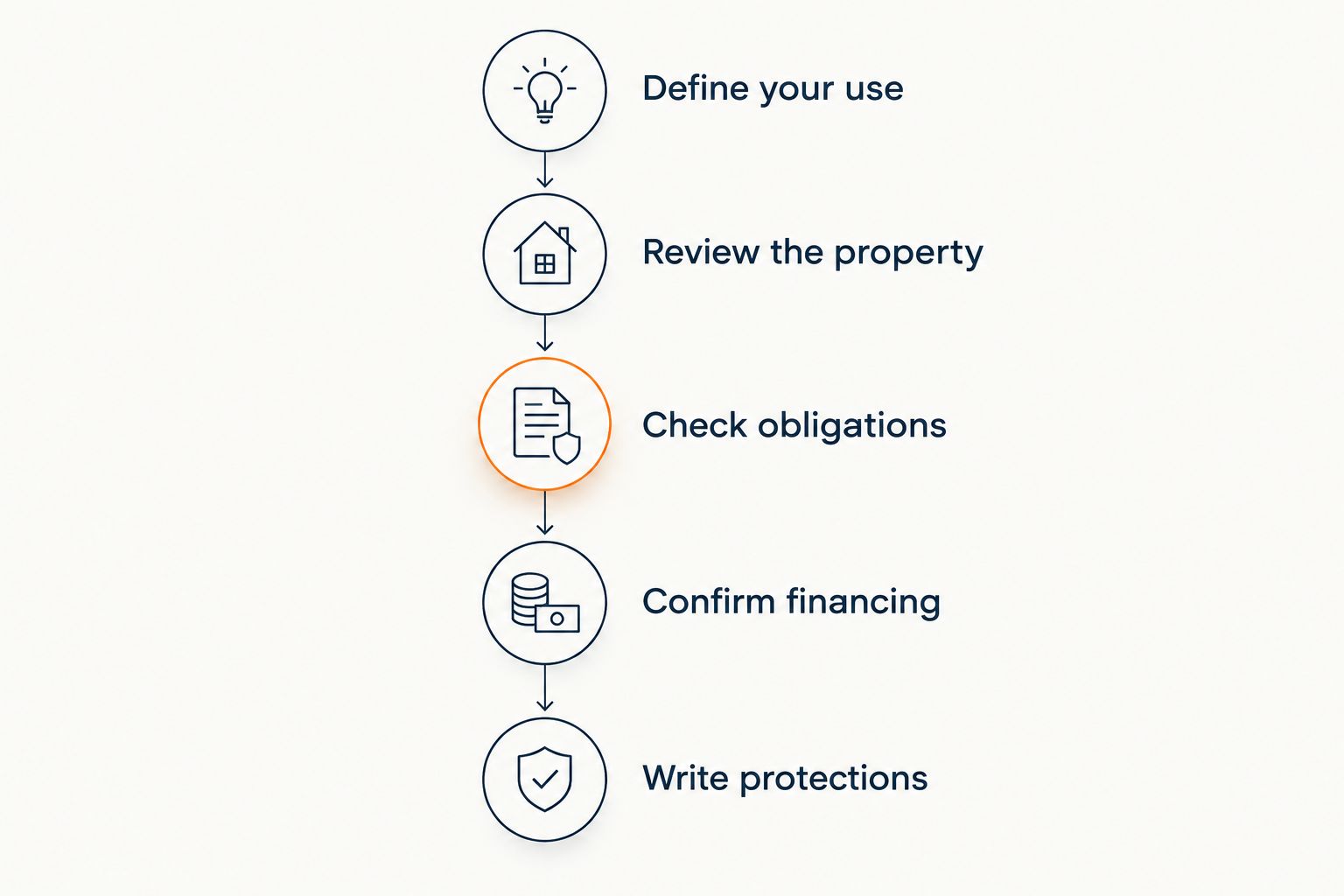
Do not mistake this sequence for a requirement to finish every investigation before offering. The practical question is which facts you need first and which investigations the contract allows you to complete afterward.
Match the property to the way you will use it
Your intended use changes the questions worth asking. These are due-diligence priorities, not statements about Cambridge Square's rules or any particular home's eligibility.
| Intended use | Best for | What supports the choice | Main limitation to check |
|---|---|---|---|
| Primary residence | Buyers planning to live in the home | A layout and location that support your actual routine | Parking, upkeep, and restrictions still need review |
| Rental property | Buyers seeking an investment property | Documented permission for the intended rental use | Rental restrictions, insurance, and financing requirements |
| Home with planned changes | Buyers who need to adapt the property | A property that supports the intended work | Approval requirements and physical feasibility |
For a primary residence, walk through an ordinary weekday. Where will you park, bring in groceries, take calls, and store the things you use? Answering those questions is more useful than deciding whether the house looks good furnished.
For an investment, verify permitted use before building a financial plan around it. Do not treat another owner's rental activity as proof that your intended arrangement is allowed.
For planned changes, describe the actual work. A fence, exterior alteration, or converted space raises different questions. Ask the appropriate authority and any applicable association what approvals are required before treating the project as part of the purchase.
Read the documents that govern the address
Ask for the deed information, available survey, recorded restrictions, and applicable association materials. A survey depicts property boundaries and specified features; an easement gives another party certain rights to use part of a property.
Resolve a document conflict before relying on a sales description. If the listing suggests one arrangement and the records describe another, ask the closing professional or an attorney to explain the difference.
If an association applies, request its governing documents and current financial information. Ask about owner responsibilities, approval procedures, enforcement matters affecting the property, and any pending obligations. Establish who maintains each relevant feature rather than assuming that a maintained appearance means someone else handles the work.
For a 2026 purchase, ask whether the documents supplied are current and whether amendments exist. An older copy without its amendments is not a reliable basis for deciding what you can do.
Keep a short unresolved-items list:
- Which boundary or access questions remain open?
- Which restrictions affect your intended use?
- Which maintenance duties belong to the owner?
- Which approvals are needed for planned changes?
- Which documents still need professional explanation?
Inspect beyond the presentation
Fresh paint and attractive furnishings do not establish the condition of a roof, foundation, or mechanical system. Arrange an independent home inspection and ask the inspector which areas were inaccessible or outside the inspection's scope.
An inspection is a review of observable conditions, not a guarantee against future repairs. Read the report's limitations as closely as its findings. Where the inspector recommends a specialist, understand the issue before deciding whether to proceed.
Ask specifically about visible moisture, drainage, electrical concerns, plumbing, heating and cooling, and evidence of past repairs. These are inspection topics—not claims that a Cambridge Square property has defects.
For a 2026 offer, decide how you will handle inspection findings before the deadline arrives. Ask your agent what the proposed inspection terms permit: further investigation, requests to the seller, or termination under the agreement. The signed language controls your options.
A useful question is not simply whether the home passed. Ask what needs attention, what remains unknown, and what that means for your willingness to own it.
Test daily fit rather than assuming it
Schedule 2 visits at different times if access permits. This is a practical recommendation, not a claim about local traffic or neighborhood conditions. Use the visits to observe the property under different circumstances.
Check parking access, nearby activity, lighting, and the route between the home and the places you actually use. If outdoor space matters, spend time there rather than judging it through a window.
Test your own commute at the time you expect to travel. A map's route is useful for planning, but it does not answer how that trip feels within your schedule. Do the same for recurring appointments and other essential trips.
Keep the comparison focused on your needs. Describe observable property and place features, not assumptions about the people who live nearby or who belongs in the neighborhood.
Why the right offer varies by property
The neighborhood name alone does not determine sensible offer terms. Build your decision around these factors:
- Comparable sales. Ask for recent closed sales and an explanation of meaningful differences in condition, size, features, and location.
- Physical condition. Inspection findings and unresolved repair questions affect what you are agreeing to own.
- Documented obligations. Restrictions, maintenance duties, and applicable association requirements change the ownership decision.
- Financing requirements. Loan approval and the lender's property review affect which conditions need protection.
- Possession timing. The date you receive access must work with the seller's agreement and your moving plans.
- Your intended use. Occupancy, investment plans, and proposed changes require different verification.
Ask your agent to distinguish evidence from negotiating preference. A seller's requested terms describe what the seller wants; they do not establish what works for you.
For your 2026 comparison, keep notes in the same format for each property. That makes it easier to see whether one home genuinely fits better or simply made a stronger first impression.
Confirm financing and the handover in writing
Ask your lender to review the specific property and proposed terms. An appraisal is an opinion of value used in the lending process; it is not a home inspection. Ask what happens under your agreement if the appraisal does not support the purchase terms.
A contingency is a contract condition that must be satisfied or addressed under the agreement. Financing and inspection contingencies serve different purposes. Understand each deadline and the notice required to use the protection.
Give possession the same attention. Closing, when the transaction is completed, and occupancy, when someone has the right to use the home, are not automatically the same arrangement. If the seller remains after closing or you seek access beforehand, get the terms documented and reviewed.
Keep 1 shared deadline calendar for the purchase. Record the contractual dates and who is responsible for each action; do not substitute an informal reminder for advice about the agreement.
Should I make an offer before receiving every document?
You do not need to treat an unanswered question as an acceptable risk. Ask whether the offer can preserve a meaningful opportunity to review the missing material and what happens if it is unacceptable.
Do not assume a general inspection clause covers every document concern. Have your agent explain the actual language and seek legal advice when the issue requires contract interpretation.
What should I ask my agent before signing?
Ask 3 questions: What is verified, what is still unknown, and what protects me if the unknown changes my decision? Those questions connect the property review to the contract rather than leaving them as separate conversations.
Creativity Team's real estate advisory role covers buying, selling, relocating, and investing. Bring the unresolved questions to the conversation, not just the listing you like.
Discuss your next offer
Talk through your intended use, unanswered property questions, and offer priorities.
FAQ
What should I check first when comparing Ooltewah homes for sale?
Start with your intended use, then verify property condition, ownership obligations, and financing fit. For a Cambridge Square home, confirm the details for the exact address rather than relying on neighborhood assumptions.
Does a Cambridge Square home have association rules?
Verify whether an association applies to the specific property and request the governing documents. Do not assume the answer from the neighborhood name or another owner's arrangement.
Can I rent out a home I buy in Cambridge Square?
Confirm the permitted rental use before committing to an investment plan. Review applicable restrictions, local requirements, insurance terms, and lender conditions for the property.
Do I still need an inspection if the home looks updated?
Updated finishes do not replace an independent inspection. Ask what was inspected, what was inaccessible, and whether any finding requires a specialist.
Is an appraisal the same as a home inspection?
An appraisal addresses value for the lending process; a home inspection addresses observable property conditions. Neither replaces the other, and both have limits.
Can I move in as soon as the purchase closes?
Your right to move in depends on the written possession terms. Confirm when access transfers and document any arrangement that separates occupancy from closing.
What should I bring to a conversation about making an offer?
Bring the property address, your intended use, financing status, timeline, and unresolved questions. Separate essential requirements from preferences so the discussion stays focused on your decision.
One last thing
Before signing, write down the fact that would change your mind. It might be a use restriction, an unresolved condition, or possession timing that does not work. Then ask where that fact is verified and how the agreement addresses it.
A good offer is one you understand, not merely one a seller accepts. For a 2026 purchase, leave yourself a clear record of what you checked and why you chose to proceed.
Creativity Team at Keller Williams Realty, Greater Downtown offers private advice without pressure. Bring your questions when you are ready. Helping You Make Chattanooga Home.