
Before buying in Seven Lakes, review the property’s condition, confirm the association obligations attached to the address, and check that your intended use fits the recorded restrictions. When comparing Ooltewah homes for sale in 2026, do not treat a listing description as a substitute for inspection reports, association documents, or written answers. Your offer should leave room to investigate unresolved questions before you commit.
- For Ooltewah homes for sale, check the house, association obligations, and recorded restrictions before committing.
- Creativity Team suits buyers seeking private real estate advice in Ooltewah and the Chattanooga area.
- Request current association documents; do not assume amenities, maintenance responsibilities, or permissions from a listing.
- Use inspection findings and written association answers to decide whether the property fits your plans.
Why this matters
A house can meet your space needs while its ownership obligations do not. An inspection addresses the building; association records address a different set of questions, including restrictions, shared responsibilities, and financial obligations.
Review both before deciding that a property fits. Creativity Team’s private real estate advisory approach focuses on buying, selling, relocating, and investing across the Chattanooga area, including Ooltewah. Bring your intended use into the conversation early, whether you want a primary residence or an investment.
This 2026 checklist is a request list, not a statement of Seven Lakes’ current rules. Confirm every property-specific answer against the documents that apply to the address you are considering.
What should you check before buying in Seven Lakes?
Start with the address, then work through the house, association records, and your purchase contract. Keep a written list of open questions so an encouraging showing does not replace the investigation.
- Identify the property. Confirm the parcel, legal description, lot boundaries, and documents attached to the proposed purchase.
- Request association records. Ask for applicable restrictions, current rules, financial records, and written information about outstanding obligations.
- Inspect the house. Review condition, repairs, drainage, and any systems that require specialist attention.
- Check your plans. Investigate intended alterations, parking, fencing, leasing, or other uses before assuming permission.
- Resolve contract questions. Discuss investigation deadlines, document review, repair negotiations, and unresolved risks with your agent and appropriate professionals.
Some records answer different questions even when they describe the same property. Use this distinction to avoid asking an inspection report to establish something it cannot establish.
| Review | Best for | What it contributes | What it does not establish |
|---|---|---|---|
| Property inspection | Understanding observable condition | Findings about the house and recommendations for further evaluation | Association permissions or legal boundaries |
| Association document review | Understanding shared obligations | Applicable rules, responsibilities, and disclosed financial information | The physical condition of the house |
| Survey and title review | Investigating property rights | Information about boundaries, recorded interests, and exceptions | The condition of building systems |
These reviews complement one another; none replaces the others. Ask the relevant professional to explain anything that changes your decision or your responsibilities after closing.
Check the property beyond the showing
Condition and repairs
Ask for the seller’s available disclosures and records of repairs, replacements, permits, and warranties. Compare those records with the inspector’s findings rather than treating either source as the whole picture.
Separate cosmetic preferences from unresolved condition questions. Paint is a preference; unexplained moisture needs investigation. If an inspector recommends further evaluation, arrange it within the time your contract allows.
For your 2026 purchase file, keep reports, photographs, repair agreements, and supporting records together. A verbal explanation is harder to revisit than a dated document identifying the issue and the agreed response.
Drainage and outdoor areas
Look at how the ground slopes around the home, where downspouts discharge, and whether retaining walls or visible drainage features need further review. Ask who maintains any feature that serves more than the property itself.
Do not infer flood exposure from appearance. Review applicable flood information and discuss insurance requirements with your lender and insurer. If the property raises drainage concerns, ask an appropriate specialist to evaluate them.
Boundaries and access
A fence, hedge, or maintained strip of grass does not establish a legal boundary. Ask whether a survey is available and whether the planned purchase calls for an updated one.
Review access and easements, which are rights allowing someone to use part of a property for a specified purpose. Resolve a boundary or access question before planning a fence, addition, or outbuilding. A convenient location for an improvement is not proof that you can build there.
Request the association documents that apply to the address
Begin by confirming the association’s identity and the documents governing the property. Do not assume a nearby home has identical obligations or that a listing contains every applicable restriction.
Request the current versions and ask whether amendments or other governing documents also apply. For a 2026 purchase, an older packet needs to be checked for updates rather than accepted as current.
Rules and recorded restrictions
Ask for the declaration or covenants, bylaws, rules, and applicable amendments. Covenants are recorded restrictions governing property use; their wording matters more than an informal summary.
Read the provisions connected to your actual plans. A buyer considering exterior changes needs different answers from a buyer whose main concern is leasing. If language is unclear or conflicting, seek legal interpretation rather than relying on a neighbor’s experience.
Financial obligations and shared maintenance
Request written confirmation of regular assessments, which are charges used to fund association expenses. Also ask about special assessments, outstanding balances, transfer-related obligations, and responsibility for settling any amounts due at closing.
Review the available budget, financial statements, reserve information, and meeting records. Reserves are funds set aside for future expenses. These records help you ask informed questions; they do not guarantee that future assessments will remain unchanged.
Ask whether major work is approved, proposed, or under discussion. Keep those categories separate. A discussion in meeting minutes is not the same as an adopted obligation.
Amenities and responsibility
If an amenity influences your decision, verify access rights, operating rules, maintenance responsibility, and any separate obligations. Do not assume that an amenity visible nearby belongs to the association or is included with ownership.
Ask the same questions about shared landscaping, private roads, drainage features, and other common areas where applicable. Identify who maintains each feature and which document assigns that responsibility.
Why the right checklist varies by property
The same neighborhood name does not answer every ownership question. Let the specific house and your intended use determine where you spend investigation time.
- Property condition: An inspection recommendation creates a different next step from a cosmetic preference.
- Lot and boundaries: Easements, drainage features, and proposed improvements require address-specific review.
- Governing documents: Applicable restrictions and amendments determine what needs confirmation.
- Shared obligations: Maintenance responsibilities and disclosed financial commitments affect ownership planning.
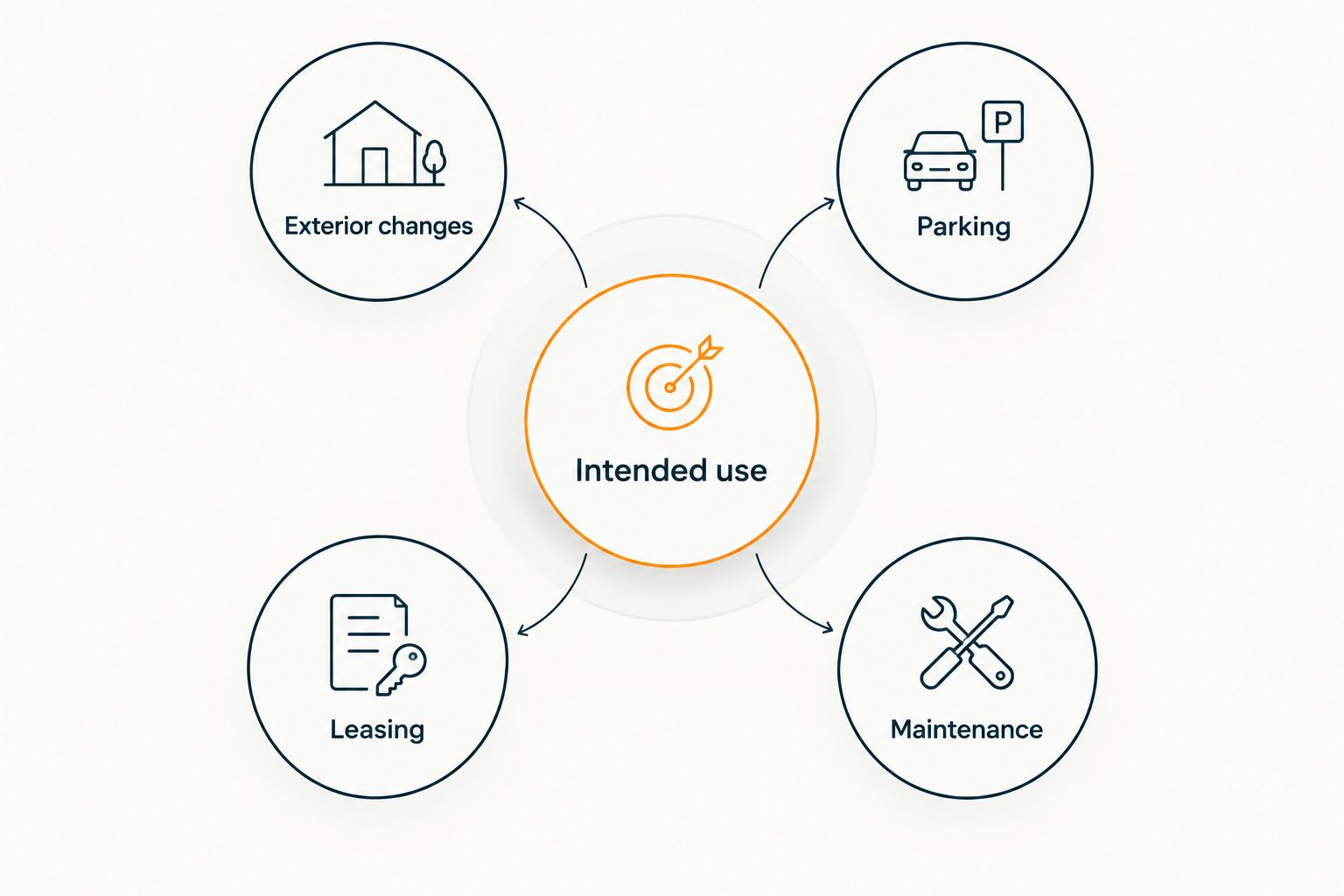
- Intended use: Living in the home, leasing it, or changing its exterior raises different questions.
- Purchase terms: Your signed contract determines the deadlines and procedures for investigating and responding.
Do not shorten the process because another property seemed straightforward. Carry useful questions from one showing to the next, but obtain fresh answers for each address.
Check your plans before you make assumptions
Write down what you intend to do with the property before reviewing the restrictions. Specific questions produce more useful answers than asking whether an association is restrictive.
Use these headings for your notes:
- Exterior changes: Ask about approval procedures for fencing, additions, landscaping, and outbuildings relevant to your plans.
- Parking: Confirm applicable rules before relying on space for additional vehicles, trailers, or equipment.
- Leasing: Verify whether your proposed rental arrangement is permitted and what conditions apply.
- Maintenance: Identify responsibilities for the house, lot, and any shared features.
Ask for written confirmation tied to the applicable provision. A seller’s existing fence or parking arrangement does not establish that your proposed change will receive approval.
For an investment purchase, investigate leasing rules before relying on projected rental use. Ask a qualified professional about legal or tax questions outside the brokerage relationship.
How should your offer protect time for these checks?
Your offer should address the investigations you need and the time required to complete them. A contingency is a contract condition that can provide specified rights if its requirements are not met; its exact wording controls.
Discuss inspection, financing, appraisal, title, and association-document questions before signing. An appraisal is an opinion of value used in the lending process, not a substitute for a property inspection.
Ask your agent to identify each relevant deadline and explain what response the contract requires. Do not assume that requesting a document automatically extends your review period.
For a 2026 relocation, coordinate travel and specialist appointments around those deadlines. If a necessary answer remains outstanding, discuss the available contractual options before the deadline passes.
Can you rely on the seller’s explanation of association rules?
Use the seller’s explanation as a starting point, not the final authority. Request the governing provision and clarify whether the answer comes from a recorded document, an association representative, or personal experience.
An existing alteration also deserves context. Ask whether approval records are available and whether any unresolved compliance matter affects the property.
What should you do if an important answer is still missing?
Identify the missing answer, who can provide it, and when you need it under the contract. Then decide with your agent and relevant professionals whether to seek more information, negotiate a change, or use an available contractual right.
Do not replace an unanswered question with a reassuring assumption. The more central an issue is to your intended use, the more important it is to resolve before proceeding.
FAQ
What should I check first when looking at Ooltewah homes for sale in Seven Lakes?
Start with the property's condition, applicable association documents, and your intended use. Review those alongside your contract deadlines so you know what must be resolved before proceeding.
Does a home inspection cover association rules?
No, a home inspection does not establish association permissions or obligations. Review the governing documents separately and seek legal advice when their meaning is unclear.
Can I assume a fence is allowed if neighboring homes have one?
No, a neighboring fence does not establish permission for your proposed fence. Check the applicable restrictions, approval process, boundaries, and easements before planning installation.
How do I find out what association assessments apply?
Request written confirmation of the assessments and other obligations attached to the address. Ask about outstanding balances, approved special assessments, and how amounts due will be handled at closing.
Can I buy a Seven Lakes home to rent out?
Verify the property's applicable leasing restrictions before relying on rental use. Ask whether your proposed arrangement meets the governing documents and any other applicable requirements.
Who can help me evaluate a Seven Lakes purchase?
Creativity Team provides private real estate advice for buyers in Ooltewah and the Chattanooga area. Use an inspector, lender, insurer, surveyor, or attorney for questions within each professional's expertise.
One last thing
Keep a decision record, not just a document folder. For each concern, note the question, the supporting document, the answer, and whether it changes your willingness to buy.
That record helps you distinguish a resolved issue from one you have simply stopped discussing. A home that fits your plans should still fit after the paperwork is read.
Bring your shortlist and unanswered questions to Creativity Team for a private conversation about the next step.
Discuss your Ooltewah purchase
Bring your shortlist, intended use, and unanswered property or association questions.
Helping You Make Chattanooga Home.